Sometimes Doctors Need Doctors
 Being aware of every heart beat for several days is pretty exhausting. Especially when quite frequently every third or fourth beat is dropped and you feel like a balloon has just popped inside your chest each time. It wakes you up at night and your clinic staff start worrying that you’re looking a bit pale and tired. And concentrating on Abraham the Amharic Tutor trying to introduce you to gerundive verbs while your heart is skipping beats is pretty challenging. I don’t think I learned much that day. In fact it was after that particular lesson on Monday lunchtime that I gave in and told my staff I really wasn’t feeling too good. Sister Aster happened to know the head doctor at the Addis Cardiac Hospital (see Chris’s blog post last week about how important networks are) and phoned to book me an appointment to have an ECG the next day. Thus began my first personal experience of medical care in Addis outside of my own clinic. It was instructional, to say the least.
On Tuesday lunchtime Chris and I set off for the hospital, with my heart jumping every now and then. The car needed petrol. We drove into and out of several petrol stations that had none, and so it was that a short distance from the hospital we joined the frantic queue for petrol that Chris described last week. Thirty minutes later we located the hospital. It’s on the ring road near the airport with a big sign but only a little muddy car park into which we squeezed under the instruction of the hospital guard (who, it turns out, sleeps in the waiting room.) 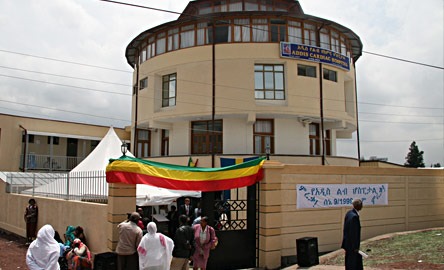 We go in through the gate into a sort of compound/yard with bilingual signs pointing to various facilities scattered around. The central main building is a circular construction, but we had to find the reception office in the surrounding buildings. We’re used to Ethiopian offices being behind glass screens in which is a small hole to communicate through and this one was no disappointment. The woman behind it knew I was coming, gave me a piece of paper and waved me to the cashier - also behind a glass screen in a small booth with the additional protection of metal bars. She was certainly safe in there. And quiet. I can’t read Amharic at the best of times, let alone lip-read. It’s a little dangerous putting your ear into the small roughly cut sharp-edged hole in the glass, but that was the only way to hear “296 birr” which I duly paid through the other hole just big enough to get your hand through.
“Sit,” she ordered.
Behind us was a waiting room in a sort of “lean-to” construction thronging with patients and relatives all looking like they’d been waiting since last week. Nowhere to sit so we stood, anticipating plenty of reading time.
“Dr Phil - Room 6!”
The order came from a diminutive white-clad nurse clutching an important-looking clip-board, pointing to the door in the circular central building. We made our way in, and I sat for a short time in an inconveniently placed chair outside Room 6 at the foot of a huge spiral staircase. The door opened a couple of times to reveal an Ethiopian chap stripped to the waist having an ECG. No privacy here then. The lack of privacy became more obvious when I was told to go in – the couch was next to a faintly tinted clear glass window with no curtains and people thronging outside. Glad I’m a bloke.
“Take off your clothes”. Oh, OK then. I assume just to the waist?
“Lay down”.
I obey. The door opens and closes as a second nurse comes and goes. The obviously inconvenient curtain that could have protected my half naked form from prying eyes was tied up in a big knot so as not to get in the way. Not wishing to do anything like introduce herself or explain the procedure or even smile, Nurse 1 comes straight at me and proceeds to put ten small gel-filled suction cups with wires attached on to my chest. Now I’m no cardiologist, but I know lead V3 definitely doesn’t go there. Never mind, I’m mainly interested in the rhythm so a stray V3 hardly matters.
“Sit down”. Err, what? I’m already laying… Oh, you mean “sit up”!
Up I get, she pulls the suction cups off, on goes a BP cuff, up goes my BP (this is all a bit stressful you know.)
“Get dressed”.
After looking sheepishly at my gel-covered hickey-spotted chest she reluctantly wipes the gel off with a tissue.
“Room 101”. Oh no – this is all getting a bit Orwellian. Will I ever be seen again?
We are ushered up the huge spiral staircase wrapped around the great big lift shaft that occupies the centre of this circular building. Another cultural event takes place when an elderly lady is ordered to give up her seat for me in the densely packed peculiarly shaped waiting area outside an equally peculiarly shaped consulting room in which is Dr Bekele. (These peculiar shapes are necessitated by all the rooms being squashed around the outer circumference of this odd circular building the bulk of which is taken up by the lift and staircase.) Once in the consulting room communication is a little one way – I ask the questions, he answers. He tells me the ECG is poor quality. I know, I tell him – the nurse put the leads on wrong. After a few minutes in which I again took my clothes off he decides I need an echocardiogram and an exercise ECG. He gives me a piece of paper and off we go to the reception booth outside. “You come 6 o’clock. Wear sports clothes” she tells me. I do a double take – 6 am my time? Not Ethiopian time (6 o’clock is midday)? No, my time. She emphasises it by telling me to come at 12 o’clock Ethiopian time. After another trip to the cashier to do some more lip-reading we head off. Ah well, at least at 6 am the traffic will be OK.
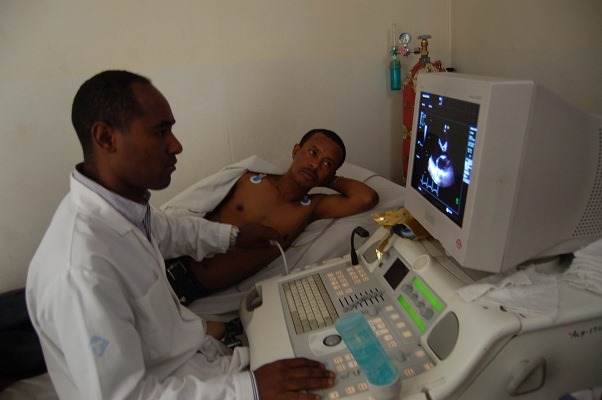 And it was. The next day I don sports wear at stupid o’clock in the morning and we head off in darkness back to the hospital. The car park is empty, the guard’s mattress is being removed from the waiting area, and we wait. An elderly Ethiopian lady is obviously waiting for the same tests, as despite being swathed in the usual Ethiopian dress, we spot a pair of Adidas trainers (probably fake) peeping out from underneath. Soon I’m in the echo room.
“Take off your clothes” yesterday’s nurse orders. I’m getting used to this.
Dr Bekele appears and I get my first ever ultrasonic view of my own heart valves. Looks OK, except every now and then a balloon pops in my chest and at the same time on the screen my heart stops briefly. Unnerving. He tells me its OK though. Off I go to the peculiarly shaped exercise ECG room containing a big treadmill. I hate exercise – especially at this time of day.
“Take off your clothes”. Next time I come I won’t put any on.
After the nurse puts the leads on in the wrong place again I complete the exercise test with no adverse effects except breathlessness (despite having a haemoglobin of 16 I am over 2,000 metres above sea level remember) and while exercising praise be my heartbeat goes back to normal (although the missed beats come back after I’ve rested.) After a further slightly one-sided chat Dr Bekele tells me the condition is benign, I should try another pill, and see him next week. We shake hands.
Off we go to the pharmacy in the courtyard to get a couple of packs of pills. The pharmacist gives me a piece of paper to give to the cashier. Oh no - more lip-reading. I hand her the paper, she taps on the computer and we wait. And wait. She mouths some words. Risking slicing it off I stick my ear in the hole in the glass and find out there’s a computer problem. It’s going slow. You need to understand that Ethiopian society falls apart if receipts aren’t issued at the point of taking money. So even though I had given her the money and the pharmacist has the pills, we have to wait for the receipt from the computer. She or I would have broken the law if we hadn’t; probably me. It took about ten minutes for the printer to finally spit out my receipt to take back to the pharmacist to get the pills.
All done. We drive back to Bingham through the now thickening traffic. While I’m changing out of my sports gear Chris cooks me a bacon sandwich (we’d found some frozen bacon in a supermarket that weekend). You can eat bacon sandwiches when you know your heart is normal.
Compliments to Dr Bekele and his team. I received a rapid, efficient, remarkably economic service with modern equipment and he clearly knew his stuff. His management was perfect and his reassurance was genuine and encouraging. One of my patients had a very serious cardiac problem and this hospital served him extremely well. I’ve only tried to make this amusing because culturally it was a very different experience from what I would have received in the UK. Addis needs more medical facilities like this.
(ADDENDUM: The symptoms have completely settled. For the curious medics amongst you, the ECG showed benign unifocal PVCs, the echo showed borderline LVH related to my hypertension for which I have been on treatment since 2007. Structurally my heart is otherwise normal, and the exercise ECG showed no changes at all. The PVCs disappeared while exercising. Dr Bekele gave me metoprolol 25 mg a day which has had no side effects and may have settled the problem as well as getting my BP under better control. The Addis Cardiac Hospital aspires to be the best cardiovascular hospital in the country, and it probably is. The whole business – consultations, ECG, echo, exercise ECG and pills – cost me about £60.)
Comments
Alan (not verified)
Sun, 17/08/2014 - 19:08
Permalink
Doctors....
Wish you better
Alan
angie (not verified)
Sun, 17/08/2014 - 19:41
Permalink
well what a relief!!
Glad you are normal Dr Phil, although it rather goes against the grain to be merely normal doesn't it?? Sounds like yet another experience to put down in your memoirs
Lana (not verified)
Sun, 17/08/2014 - 21:08
Permalink
Great to hear you feel better
Great to hear you feel better and got it all sorted out! Lana
Mum (not verified)
Sun, 17/08/2014 - 21:47
Permalink
Sometime Doctors need Doctors
Oh dear you had me quite worried!! Good to know Addis does have some modern equipment and you are now sorted.
Liz McGregor (not verified)
Mon, 18/08/2014 - 07:10
Permalink
Doctors need doctors
Thank for sharing this somewhat frightening experience in such a brilliant way. But, we are taking it seriously, as we know you are and so will be praying that that's the last of your heart flips. Malcolm had a similar experience years ago in Addis. His problem.....drinking Ethiopian coffee. Once he stopped drinking coffee, he's never had it again! Take care. Liz and Malcolm
Bethany (not verified)
Mon, 18/08/2014 - 08:20
Permalink
phew!
Well well, what an experience! I am so glad you added the addendum, I am very reassured :-) and £60 for all that?! Not bad! Would local folk struggle with that? Can one get payment plans or some sort of financial aid?
Paul G (not verified)
Mon, 18/08/2014 - 19:47
Permalink
Tis different doon yer
Doon yer 'n Debon things is very different. You have a wee syncope over the picnic table on a very hot day and your children panic and think that you are having a stroke (very understandable as three generations have gone to glory as a result of strokes) and a "first responder" arrives in five minutes, checks that you are alive and have not suffered a stroke and waits. An ambulance arrives and the crew checks that you are alive and that you have not had a stroke and goes away to someone with a bigger problem. Another ambulance arrives and the crew checks that you are alive and have not had a stroke, performs an ECG and then stays because the crew like the view and they don't want to go and treat the usual bunch of under-age inebriates on the beach. They write an unnecessarily lengthy report for the GP and finally go after generous helpings of strawberries and cream. Keep smiling through the pain.
Phil
Tue, 19/08/2014 - 15:33
Permalink
What an excellent service!
The NHS in Debon obviously doesn't have too much to do! Had a good chuckle at that Paul thank you
Mary Crawford (not verified)
Tue, 19/08/2014 - 01:27
Permalink
When a doctor needs a doctor
You been drinking too much Ethiopiian coffee??
fascinating U/S view of what's going on inside!
Glad you feel better!
Phil
Tue, 19/08/2014 - 15:34
Permalink
No!
There is of course no such thing as too much Ethiopian coffee
Rosy Palmer (not verified)
Wed, 20/08/2014 - 13:13
Permalink
Phil cardiac experience
Wow, Phil - quite an unerving time you have had. So glad all seems to have settled!
It reminds me of the time I was visiting my daughter in Kenya on her gap year and her friend had amoebic dysentery after swallowing too much Nile water! We took her to a back street clinic in Kitale where she we told to produce a stool specimen. They looked at it then and there under an ancient microscope, made the diagnosis and after a similar wait at the pharmacy and paying and waiting for the "chitty" (receipt), she .was on her way with the appropriate treatment, Al this cost about £7.00 and was done in about an hour.
In the Uk that would have taken at least a week!
Love to you both. Take care! Lovely memories of visiting Bingham and having supper with you!
Rosy and Bernard
Roz (not verified)
Sat, 23/08/2014 - 12:41
Permalink
Thank God you are okay
I too have twice been down the ECG, Echo, Exercise ECG route, fortunately with nothing serious found, but that was in the UK, once NHS, once private, and neither was a quick as yours, and the latter seemed to involve a lot of shunting in and out of CT scanners and ultrasound too. I am immensely relieved to hear that if it comes to it, Ethiopia, or at least your part of it, can handle emergencies just as well, if not better!
Chris's post talks of coffee, just posted before your event................? :-)
Hope your next update is a little less exciting!