Being an Ethnic Minority
 “Give me all your money!” demanded the scruffy young boy, holding out his hand whilst flapping it in the way beggars here always do. This request came my way while we were out and about in the countryside several months ago – a common demand, although since being here I’ve not previously been asked quite so directly. He was clearly very poor, but I had to explain to him that I had no money on me (which I hadn’t) and he slunk off disconsolately. Usually the demand is just “Money! Money!”, and our white faces make us targets - often when in more remote areas; less so in Addis where being white is not quite so unusual.
We’ve had to learn how to adapt to all sorts of things while living here, and being an ethnic minority is one of them. A Caucasian is a “ferenji”, or possibly just “ferenj”. It’s a rare day when Haile drives me to clinic and back that I don’t hear someone yell "ferenj!” at me as I go past with the taxi window open. Sometimes it’s “You! You!”, sometimes “Money! Money!” The best (or worst?) though is “China! China!”. Children obviously can’t tell the difference between a Caucasian and someone of far eastern appearance, as this happens quite a lot. The huge amount of construction in the city funded by the Chinese means there are thousands of Chinese ex-pats living here, so they are a common sight. I’m not entirely sure though what yelling at me is supposed to achieve.
There’s a tee shirt company here that prints wryly amusing tee shirts for foreigners. One says: “My name is not ‘Ferenji’!”. We once saw an Ethiopian wearing one…
Being white seems to imply I must be rich, which means in small shops I’ll sometimes be charged the “ferenji price”. So for some items that we can obtain locally we send Seble or Haile out to buy them – it’s cheaper, and they understand that. On a number of occasions when Chris has gone out shopping with Seble she has made Chris stand out of sight, because if the vendor sees Chris the price will instantly go up.
Sometimes being an ethnic minority has the opposite effect, and instead of being yelled at or charged more we are shown great respect and honour, which can be enormously humbling. That happened to us last Sunday when we were the only two "ferenji" to attend a wedding; having received the invitation by phone three days before (no “save the date” cards here).
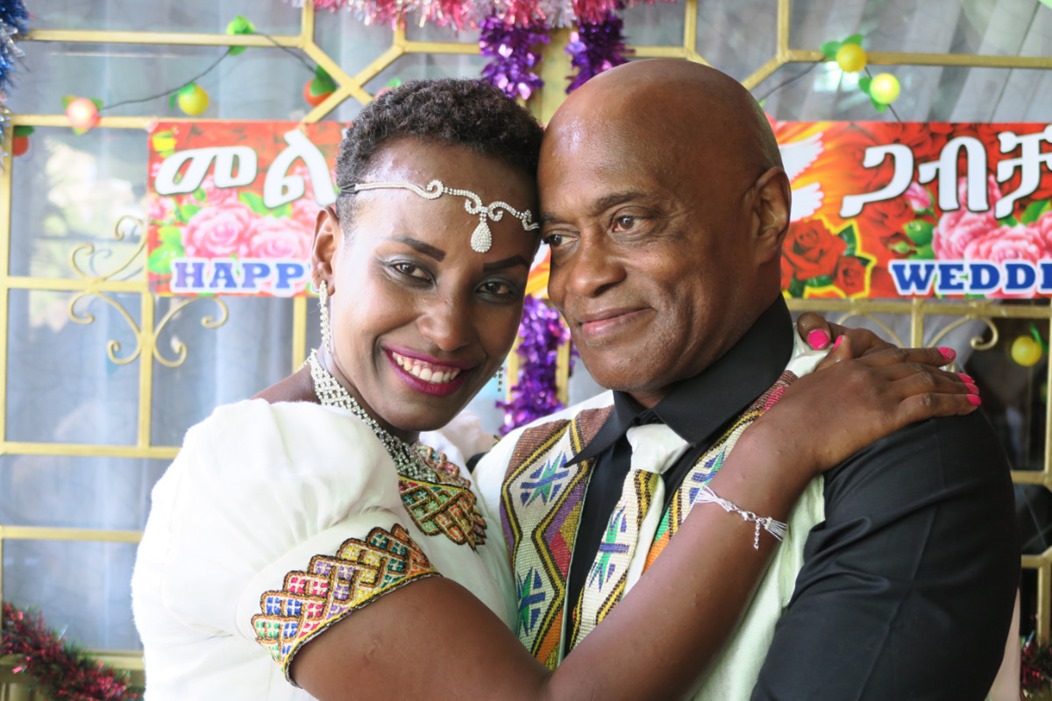 My clinic nurse Tigist met Myron from the USA on Facebook. We knew the relationship was ameliorating when he came to visit for a month, and then the Thursday before last Sister Aster received a phone call. “We must go to Tigist’s house, on Sunday” she explained, having hung up. “When?” I asked. She looked puzzled – time can be an irrelevance here. “One, one thirty, two – something like this” she replied, vaguely. “Is Tigist getting married?” I enquired, slightly puzzled. “Maybe” said Sister Aster, “I don’t know. But I think so. Bring Weyzero[1] Chris.”
So on Sunday last Weyzero Chris and I put on our posh clothes, not knowing what the day would bring. We went to our own church first, where our unusually smart appearance attracted not a few appreciative comments. (It is never possible to over-dress in Ethiopia – the smarter you are, the better. Always.) "Aha!" announced Pastor Girma, as he greeted us at the door, "You're going to a wedding!" After the service we collected Sister Aster, equally resplendent in her traditional outfit, and headed to Tigist’s house. Having been welcomed by a besuited usher sporting a bow tie, we were led into the small courtyard in 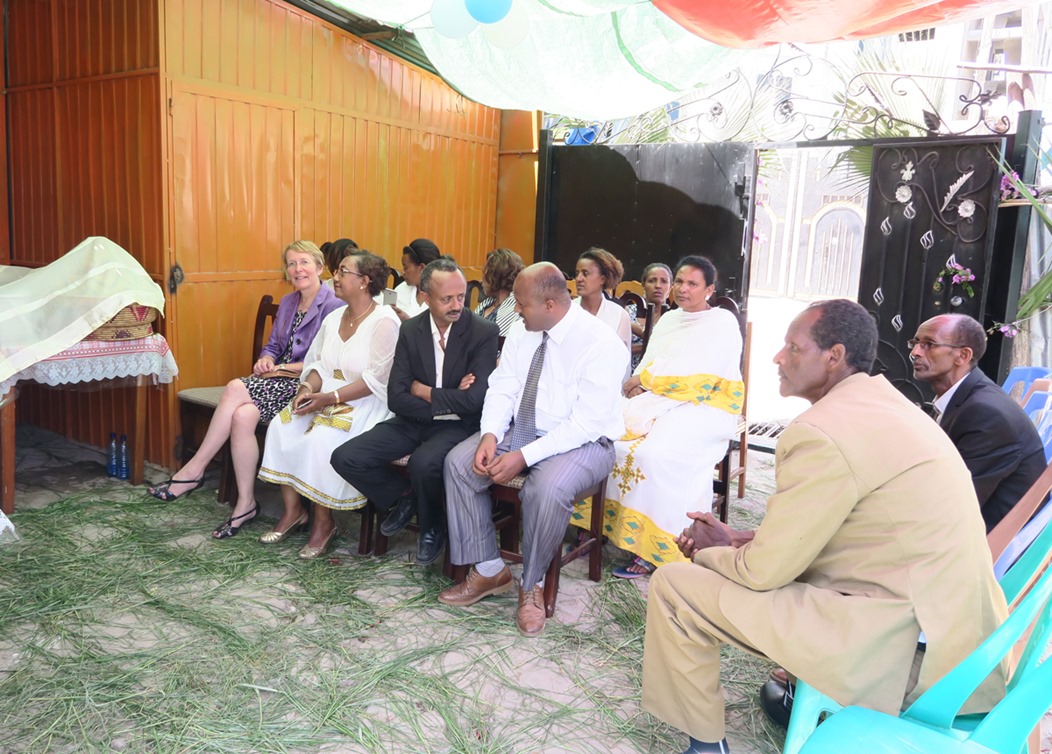 front of the house where 20 or so chairs were arranged in rows in front of the porch. On the porch was a sofa swathed in white, behind an ornate coffee table on which were groups of assorted soft drinks. Unsure where to sit, we were immediately greeted and ushered to the front row. There we waited. A huge studio photo of Tigist and Myron was brought out, with a pen to write messages around the photo on the wide black border. The first person to be asked to write? Me. I gave the pen to Chris - they’ll actually be able to read her writing.
Sometime later Myron arrived outside the gate. Having only been in the country a few days he must have had a crash-course in Ethiopian culture, but little did he know how many new cultural experiences awaited him today. As per tradition, Tigist’s sisters tried to stop him coming in, laughing and cheering. Once he had overcome this barrier, he had to make his way into the house to find his bride. Eventually they emerged on to the porch, arm in arm. Were they married yet? We didn’t know. After Tigist and Myron had taken their places on the couch, grace was said by an older man in a smart suit still proudly displaying the yellow “Made in Milan” label stitched to the outside of the left sleeve. Tigist and 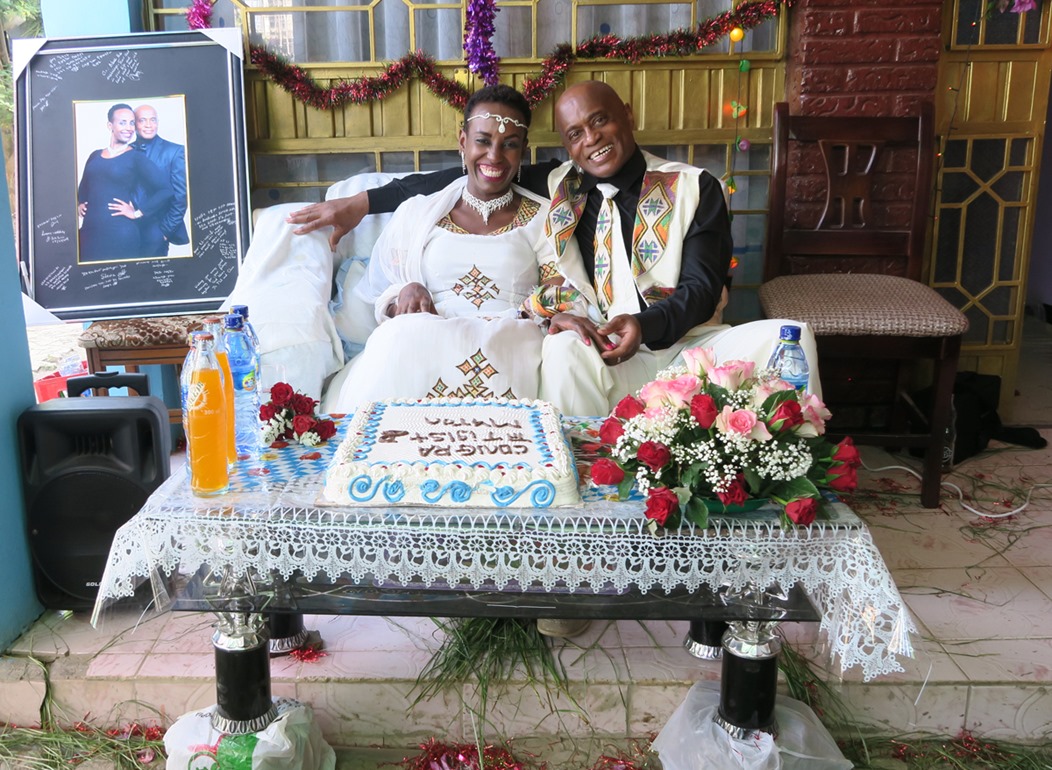 Myron were the first to go to be served the traditional food. The next person to be served? Me. Unwittingly receiving an injera meal that included raw meat, I returned self-consciously to my seat as the other guests were served. My heart went out to Myron as he sat eating in front of all the guests, and Sister Aster leaned over to me and whispered, aghast, “He’s rolling with two hands!” Another cultural lesson – only tear up injera, roll it up and eat it with your right hand (no cutlery of course). Tigist’s mum came round with more injera. The first person to be offered more? Me. After the food, the cake. “Congra to Tigist and Myron” it said, and they cut it up to cheers and clapping. A family of modest means, they only had a few plastic plates and forks to serve the cake with, and these were given to … us. The rest of the guests received their cake on hand-made cardboard plates, which they ate without a fork. We ate the cake and wondered – are they married yet? We didn’t know.
Coffee would come soon – we knew this because we could smell it being roasted. Sure enough, the tiny cups of strong sweet coffee appeared, and we were served first. Tigist and Myron did something involving intertwined arms whilst eating cake and having a drink. Were they married yet? We didn’t know. before the coffee Tigist and her relatives and a rather fish-out-of-water-looking Myron had done some dancing that we have seen at weddings before – and it’s always been after the vows, so now we think they are definitely married.
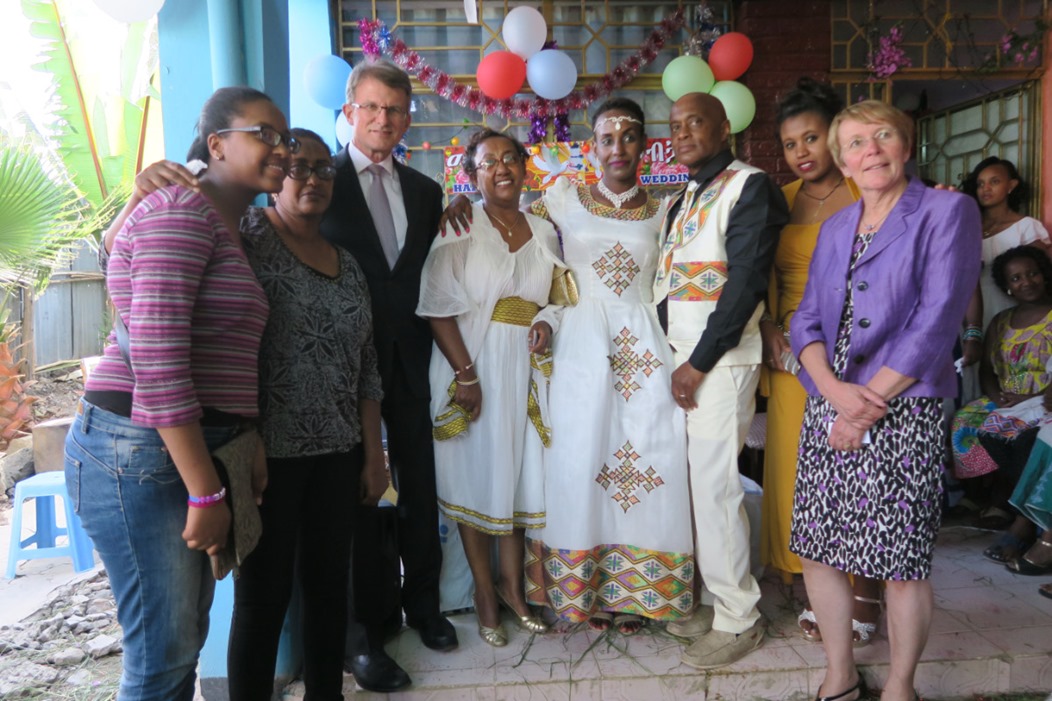 After the dancing, the coffee and many greetings, we bade our hosts farewell and headed home, confident we had definitely been to an actual wedding, and feeling that we had been treated like royalty. A great honour, that we shall never forget. Here’s wishing God’s richest blessing on Tigist and Myron in their new life together.
1 A term of respect for a married woman. "Mrs" is the English equivalent, although lacks the right amount of respect.
Comments
Bethany (not verified)
Mon, 01/05/2017 - 20:11
Permalink
Tigist
Goodness, what an experience! For you guys, as well as the groom! Great to read about. I'd imagine the cultural hurdles were aplenty. Quite humbling I am sure.
Hannah R Rodger (not verified)
Thu, 04/05/2017 - 07:10
Permalink
Weddings
What a stark contrast. Very pleased for tigest. Smiling widely as usual. You seem to have had quite the variety of experiences when going to Ethiopian weddings. However I suppose it is the same with British ones. Just shows that the months of planning we tend to do before a wedding doesn't change the outcome. You still end up married.xx
Andrew Mayo (not verified)
Sat, 17/06/2017 - 20:35
Permalink
The wedding
A biit late iin response but just to say how much I enjoyed the story...and very well told it was too!
Andrew